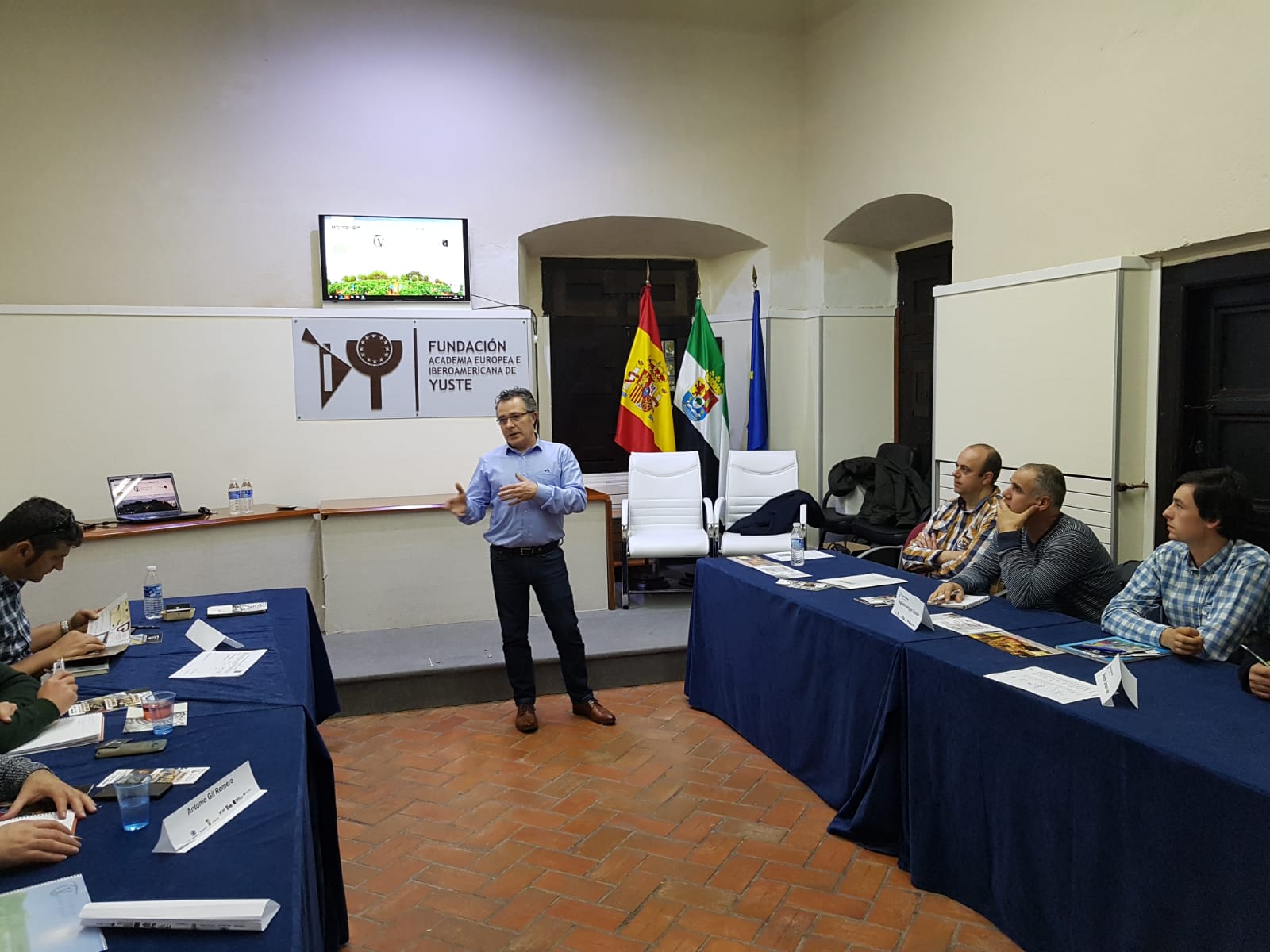
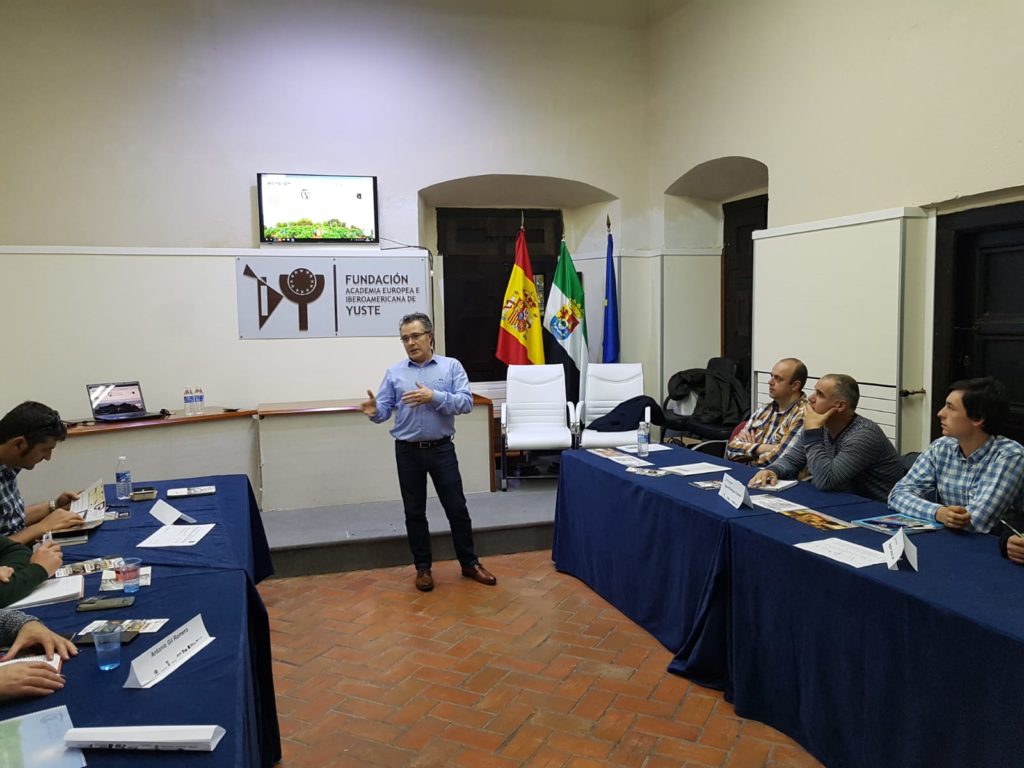
Mr. Juan Miguel Tolosa has participated as a speaker in the Entrepreneur-Innovative Edition Program of the University of Extremadura in collaboration with the UEX University Foundation, directed by Mr. Ricardo Hernández Mogollón.
VEGA TOLOSA FAMILY PAYMENTS
Don Juan J. Jiménez (University of Castilla-La Mancha, Spain)
THE BUSINESS
Pagos de Familia Vega Tolosa, S.A. (Sociedad Anónima) – VEGA TOLOSA – is a Spanish family business active in the production of organic wines with the ‘Manchuela’ designation of origin and wine tourism. It is located in the municipality of Casas Ibáñez, between the valleys of the Júcar and Cabriel rivers, in the region of La Manchuela, in the province of Albacete, in the Autonomous Community of Castilla-La Mancha (Spain).
Another company of the family, AGROTOLPE, S.A.T. (Cooperative, Agricultural Society of Transformation), is dedicated to the cultivation of non-perennial species (vine, cereals and legumes) and to activities to support agriculture. Both activities are complementary in so far as the latter company supplies the wine production for the former. It has 220 hectares of vineyards under the certified organic cultivation regime. They are located in an altiplano 750 meters above sea level and 120 kms. from the Mediterranean Sea, which allows the entry of humid and cool winds in summer, and allows thermal variations that help the slow ripening of the grapes. In addition, the family has 500 hectares of organic cultivation of cereal and grain legumes for human consumption (lentils).
The winery is dedicated to the production of organic red, white and rosé wines. The bobal variety stands out (with vines of more than 80 years), but macabeo vines and new varieties are also grown, for white wine: chardonnay, sauvignon-blanc, viognier and muscatel; for red wine: Tempranillo, syrah, cabernet-sauvignon, merlot and garnacha tintorera. The result is approximately 2,000,000 litres of wine per year, between bulk and bottled: 600,000 bottles, with 11 different types, between red (8), white (3) and pink (1); young, semi-dry, barrel and ageing. One of the main characteristics of their wines is that, in addition to being organic, they have been adapting to be liked by new consumers, younger, who demand wines more adjusted to their tastes. Wines that have obtained awards and recognitions such as:
-Gold Medal in International Biological Wine Competition in Paris (2018)
-Gold Medal in Brussels World Contest (2018)
-Gold Medal in CLM Grand Selection Contest (2018)
-Gold Medal in National Competition Vinespaña (2018)
-Gold Medals in Wines from Spain from United Kingdom (2018)
-More than 90 points in the best Wine Guides (2018)
A FAMILY COMPANY
The first reference to the existence of a winery by an ancestor of the family dates back to 1905. The great-great-grandfather of the family, D. José, married to Dña. Ana, they had a jaraíz, a small family winery for self-supply, as was then common in the area, as well as having an oven or a mill. The property passes to the next generation, until reaching D. Juan José Tolosa Valverde (78), second of three brothers, married to Dña. Mariluz, who decides at the time of her father's retirement, in the mid-1970s, to buy the parts of her brothers and devote herself fully to the activity. Until that moment, the winery is in the center of the village, next to the family house, it is very small and sells wine in bulk to surrounding customers.
It will be in the mid-1990s when Mr. Juan José Tolosa Valverde decides to take advantage of a situation - the start-up of a local grape variety, bobal, is being encouraged, with the purpose of planting breeding varieties - to buy land in which those vines were planted, but without intention of starting the vines, already aged. At the same time, it maintains 150 hectares of lentil, wheat and barley cultivation. His son Juan Miguel Tolosa Pérez joins the activity.
In 1998 the father, Juan José Tolosa Valverde and the brothers, Juan Miguel (52) and Emilio José (47) Tolosa Pérez decide to build a new winery, more modern, more practical and functional for the new purposes of the family, the production of bottled wines of higher quality, with its own brand, and its commercialization worldwide. All three participate in family businesses (viticulture -60%-, cereals and legumes -40%-), viticulture being the main business. The political-legal circumstances mean that the project is finally located in the new industrial estate of Casas Ibáñez, instead of in the countryside, as was the original idea.
The father makes way for them in business and the brothers decide to share their responsibilities, so that Juan Miguel takes charge of the winery and Emilio José of the agricultural holding. On the farm, the vineyards are cultivated in a natural and ecological way, respecting the biodiversity of the area, in which native flora and fauna coexist, among olive trees, pines and holm oak trees.
The Tolosa family is actively involved in the company's activity (Figure 1). The two brothers, Juan Miguel and Emilio José, are co-owners - along with their father - of the different family businesses. The winery is managed by the eldest of the brothers, Juan Miguel, and their respective wives, Ma. Jesus (51) and Ma. José (38), work in management positions, taking care of wine tourism visits and tastings, and accounting, respectively. Juan Miguel's eldest daughter, Mariluz (24), carries out commercial tasks in the area closest to the winery and supports guided tours and wine tourism tastings. Juan Miguel's second daughter, Rocío (19), studies oenology, with the intention of also linking to the family business. The children of Emilio José, Juan Ángel (9) and María (5) are still small, but they already assume family activity as their natural family environment. The Tolosa brothers highlight the entrepreneurial spirit of their mother, Mariluz Pérez, from whom they claim to inherit that constant orientation to business, and their know-how guiding the decisions of the patriarch of the family, D. Juan José Tolosa.
CHALLENGES AND OPPORTUNITIES FOR GROWTH AND SUCCESS
In 2001, at the beginning of the activity in the new winery, 800,000 liters of wine were bottled (60%) and the rest of the production was still sold in bulk (40%). The market goes from being regional to being national. In 2002 began its export activity, which is dedicated to the 60% production, with the main markets being Europe (highlighting Germany and the United Kingdom), Asia (highlighting Japan and China) and the United States, mainly. The international market is served by specialized distributors, who look for new wines and new varieties for their customers and find in VEGA TOLOSA wines differentiated products, quality, organic and at a good price. The relations with these distributors are carried out by an export manager. The 40% the remainder is intended for the domestic market, which is served by distributors (40%) managed by a commercial agent of the company's workforce and by commission agents working with restaurants and gourmet shops (20%). The remaining 40% of the national market are direct consumers who buy in the company's own store or through the online store.
A new line of business, growing, is wine tourism. VEGA TOLOSA has incorporated in 2014 the guided oenological visits and tastings of its organic wines in the winery. In this case, given the importance of the activity, it is carried directly by D. Juan Miguel, assisted by his wife and daughter. Before applying it, he did benchmarking work, visiting other leading wineries in this activity. A new reform was carried out in the winery, to make it suitable for visitors and a tasting room for 20-25 people was built. Contact wine tourism agencies, the provincial hospitality association and rural tourism associations, in particular, take advantage of the great demand that exists in the region of La Manchuela.
La Manchuela is a region, located between La Mancha and the Serranía de Cuenca, crossed by the Júcar and Cabriel rivers, which give rise to a very rugged landscape that runs between canyons, of extraordinary natural beauty. Particularly noteworthy is the municipality of Alcalá del Júcar. Alcalá is one of the most picturesque villages in Albacete, declared a historic-artistic complex by Royal Decree of 1982. The village is framed in a limestone gorge that describes the Júcar River and its houses sit on the slope of the meander, from the river to the castle at the top, giving rise to narrow, steep streets and cave houses excavated in the rock. The region has an Iberian, Roman and Arab past and a very rich historical, cultural and natural heritage, being one of the most visited areas of the region. There is a wide range of rural tourism: rural accommodation, typical hospitality and leisure activities and free time.
VEGA TOLOSA is also located in the region of La Manchuela, 8 km from Alcalá del Júcar, so it has concluded agreements with rural tourism companies in the area to include oenological guided visits to its winery and tastings of its organic wines in the offer of those businesses, in addition to tourists that it attracts directly from wine tourism wholesalers, travel agencies specialized in rural tourism and through its website. The activity is booming, has grown a lot in these years, includes a guided tour of the facilities of the winery and / or a tasting session of its different organic wines. In 2017, a new tasting room was inaugurated for a capacity of 100-125 people, since the previous one, for 20-25 people, has become small for the demand that exists. On the other hand, at the beginning of 2018 a restaurant is put into service, in the same winery, to offer restaurant services -with typical local dishes- and celebration of events, given the success of the activity. Currently, tourism is mainly of national origin: of the Valencian Community, the Community of Madrid, the Region of Murcia and other bordering areas. VEGA TOLOSA is very present and active in social networks: FacebookO, TwitterO, YouTubeO and Google+0O, to disseminate their activities and capture the attention of their target audience. The work of managing social networks is carried out directly by Juan Miguel, to maintain direct contact with potential customers.
Its good relationship with agencies specialized in wine tourism and rural tourism and its visibility through its own website, augur a rapid growth to the activity and a new line of income by the direct sale of its wines and other organic products. Juan Miguel counts on his daughter Mariluz to consolidate this new line of business.
In addition, the family also grows organic cereals (wheat and barley) which it allocates entirely to international markets, mainly for the production of organic beer by German companies. Likewise, it grows grain legumes for human consumption (organic lentils) that it allocates entirely to international markets. Currently, the processing and packaging of these legumes is being considered on the farm itself and with its own brand, to market them directly in stores of organic products. In recent years it has found another line of business derived from the exploitation of a pigment presented by the leaves of the bobal variety vines in late summer and early autumn. It is highly appreciated in the pharmaceutical industry for its properties for the hematological system and can also be consumed as an infusion. A French pharmaceutical company is currently buying them. Its direct commercial exploitation is being studied.
THE BUSINESS DIMENSION
The main competitive advantage of VEGA TOLOSA (Figure 2) is both the quality of its organic wines (based mainly on a native variety, bobal, with very special characteristics), and the constant innovation in product, which leads them to adapt their wines to the tastes of new consumers (a younger clientele, who prefer wines not so alcoholic and with more current flavors and finishes). On the other hand, it adapts its product to foreign markets, using a global internationalization strategy with adaptations (modifying labels and bottling to the taste of customers in the destination countries). Another advantage of VEGA TOLOSA is that it has always been a pioneer in its strategy, first of all, betting on a wine variety in recession (bobal); secondly, by adopting organic farming in all its activities; thirdly, by adapting its products to consumer demands; fourth, beginning its internationalization before the economic crisis of 2007, which allowed it to be well positioned in international markets when other wineries began to export, to mitigate the effects of the internal economic crisis in a very mature sector. Following the ‘Diamond of Porter’ model, VEGA TOLOSA is able to take advantage of: the “conditions of the factors”, i.e. the degree of development of highly specialised local resources (bobal variety); the “demand conditions” of the competitive internal market, which lead it to improve quality and to influence constant innovation; c) and a strong internal rivalry in a “multi-country industry” such as the Spanish wine industry. In this case, the main reason for its internationalization is the evolution of the market, it seeks the expansion of the market in other countries. Finally, the way to enter these foreign markets is export, the simplest way to do so, with local agents distributing the product with contractual agreements.
CONCLUSIONS
The keys to the success of the Tolosa family are several: a) their location in a region with special conditions of the land and with special climatic conditions in the area, which has allowed them to preserve traditional indigenous crops. b) Continue to maintain a local grape variety (bobal) with differentiating characteristics and, at the same time, introduce new breeding varieties, which allow more processing possibilities and expand the offer of their products. c) Maintain the experience acquired by previous generations in the cultivation of vines and cereals and legumes, and improve the professional qualification of the staff in charge, as well as the modernization of the facilities and equipment. d) Bet on certified organic crops as a differentiating element. e) Take advantage of the Manchuela Designation of Origin, which forces them to comply with the conditions, but guarantees them the traceability of their products and the quality thereof, with the addition of their option for organic farming, This adds more value to the product. f) Constantly innovate and adapt to the tastes of customers, anticipating and knowing how to reach the national and international market. g) Find in wine tourism a complementary activity that takes advantage of the advantages achieved in agriculture and viticulture. h) Integrate the family in the management of the company and prepare the next generation. An essential characteristic of the family's business trajectory is the clear anticipated perception of the strategies to be followed, taking advantage of the circumstances to turn them into opportunities, based on the use of their main strengths.



 EN
EN  ES
ES  DE
DE