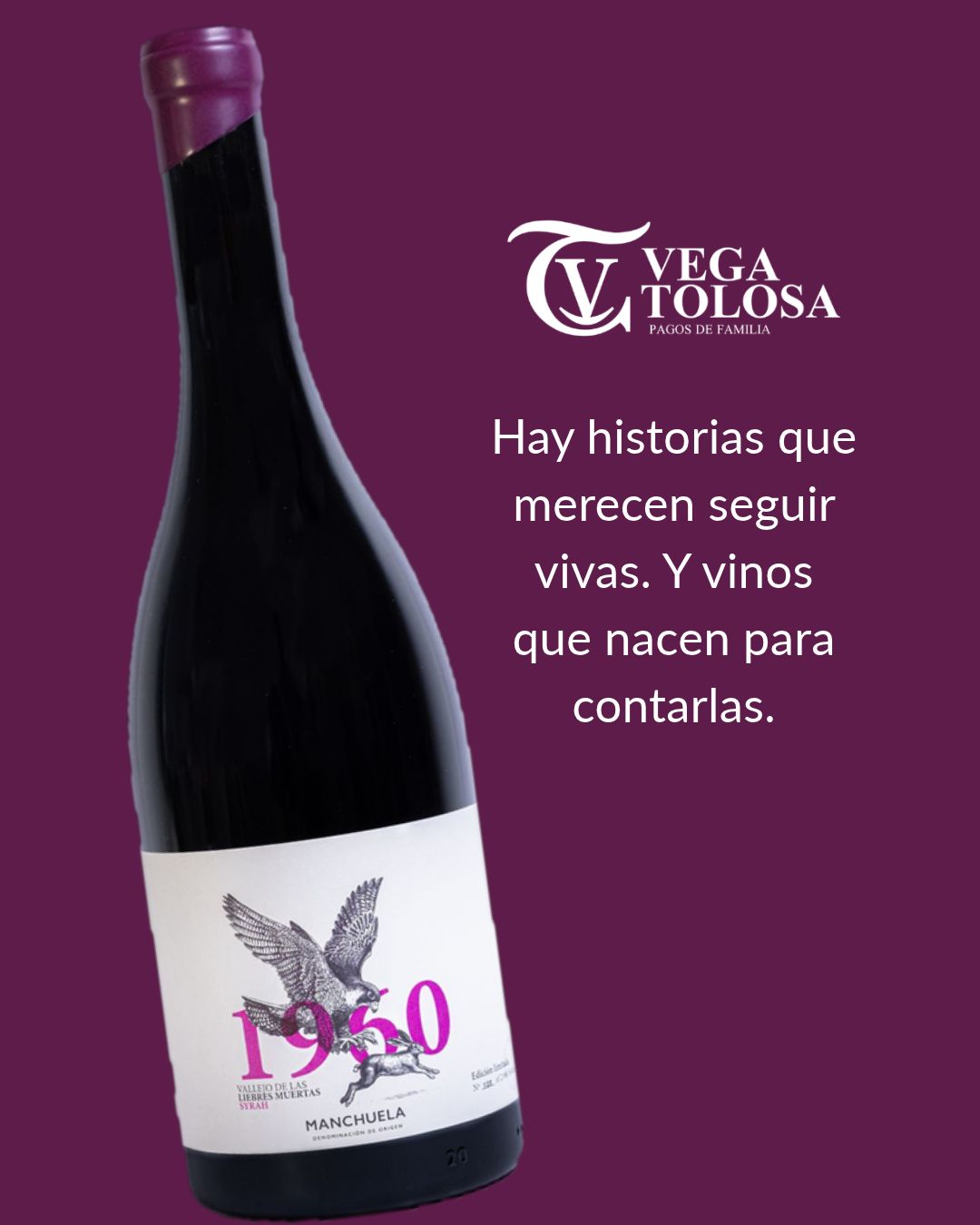
There are names that raise questions. What story hides behind a place called Vallejo de las Liebres Muertas? And how did a grape variety born far from our land get there?
The answer takes us almost a century back, to an era marked by war, friendship, travel and the desire to move forward. It also takes us to our grandfather, José Tolosa, an enterprising man who found in a visit to France the inspiration to plant a variety that, with the passage of time, would end up being part of the history of our family: Syrah.
Today, that decision is still alive in our vineyards and gives rise to a wine that looks to the past while continuing to move towards the future.
Our wine Vallejo de las Liebres Muertas It is born from a family history that began almost a century ago and today finds a new way to stay alive.
In 2026 we presented this wine, made from a selection of the best grapes from our Syrah and the barrels that have evolved the best, bringing together wines from the 2023, 2024 and 2025 vintages.
A limited edition of 2,980 bottles with which we want to preserve our memory, recognize the work of those who preceded us and continue taking care of what has brought us here.
To understand Vallejo de las Liebres Muertas, you have to go back to 1939, at the end of the Spanish Civil War.
Our grandfather, Don José Tolosa, founder in 1930 of what is now VEGA TOLOSA Family Payments, was a restless man with a great curiosity to discover what was happening beyond his land.
In those years, one of his best friends had gone to France, to the region of Hermitage, in the Rhône valley, known for its great wines. Joseph traveled there to visit him and, during that stay, discovered a grape variety that surprised him especially: the Syrah.
The experience left him with an idea that he decided to take home with him. Some branches of that variety were brought with the intention of planting them in their own vineyards and checking how they adapted to their land.
Back, he looked for a place where those strains could grow protected, in an area of a certain altitude, sheltered between valleys and slopes. He found that place in Casas-Ibáñez, in a place known since ancient times as the Vallejo of the Dead Hares.
The name has its own history. It was said that when the hares entered that valley, they were very exposed and were easy prey for birds and hunters.
A name linked to the memory of the landscape that, with the passage of time, would end up giving identity to our new wine.
In 1995 a six-hectare plantation of Syrah was carried out from those vines. Since then, this vineyard has been part of the history of our family and our way of understanding viticulture.
Today, decades after that trip to France, Vallejo de las Liebres Muertas recovers that story and takes it to the bottle.
As Juan Miguel Tolosa explains, the choice of name is also a way to recognize where we came from. Because caring for a vineyard is much more than keeping it productive: it is preserving the decisions, effort and experiences that have shaped our history.
And because, sometimes, the best way to look to the future is not to forget everything that has brought us here.
The Vallejo de las Liebres Muertas wine It is born in an environment that has a lot to say about the character of wine.
The vineyard is located in Casas-Ibáñez, at about 750 meters of altitude and approximately 120 kilometers from the Mediterranean Sea, between the valleys of the Júcar and Cabriel rivers and within the Valle del Cabriel Biosphere Reserve.
Here, the landscape alternates slopes, valleys and Mediterranean mountain. The oaks, junipers, tomillos and pine forests surround the plots and are part of a natural environment that we take care of and want to preserve.
The Mediterranean-continental climate sets the rhythm of the vine: dry and hot summers, cold winters and rainfall concentrated mainly in autumn and spring. During the summer, the Solan wind, coming from the east, helps to refresh the nights and favors a slow ripening of the grapes.
The soils, deep and rich in calcareous and mineral components, allow the roots to explore the subsoil and find the resources that the plant needs. These conditions, together with the careful management of the vineyard, contribute to obtaining grapes of great concentration and quality.
But a plot wine is not explained solely by its soil or its climate. He also talks about the people who work on it, the decisions that are made each year and the attention that each strain receives.
That is why, Vallejo de las Liebres Muertas is a wine from Paraje: because we want their identity to be linked to a specific place and the history we have built with it.
Our family works with their own and ecological vineyards, convinced that the quality of the wine begins long before entering the winery.
Organic viticulture is part of that way of taking care of the countryside. We do not use synthetic chemical fertilizers and make our own organic compost from vegetable remains of the harvest and sheep manure.
To protect the strains, we use solutions compatible with organic farming, the promotion of beneficial insects and the use of pheromones to help control certain pests.
We also pay special attention to the biodiversity surrounding the vineyards. Maintaining a living environment, where different plant and animal species coexist, is a way to protect the natural balance on which the vineyard depends.
Production is very limited. The low yields allow to concentrate the aromas and flavors of the grape, and each decision is made thinking about preserving its quality and personality.
In this project, taking care of the vineyard also means taking care of the landscape that surrounds it and the legacy that we want to transmit to the next generations.
Vallejo de las Liebres Muertas is made from a selection of the best Syrah grapes of the plot and of the barrels that have evolved in a more favorable way. To build its final expression, wines from the 2023, 2024 and 2025 vintages have been selected.
The work begins in the vineyard, with a manual harvest in boxes of seven kilos. In this way, the grapes arrive at the winery in good condition and can be carefully selected before starting the elaboration.
After a new selection, the grapes go through a cold prefermentative maceration for 24 hours. This process helps to extract the aromas of the variety and preserve its fruity expression.
Fermentation is carried out spontaneously, with the native yeasts present in the grapes. In this way we seek to respect the identity of the Syrah and allow the fruit and the origin to have a leading role.
The wine is then transferred to eight 300-litre French oak barrels, where it evolves slowly. During this stage, the wine gains complexity and structure, while time contributes to integrate its different nuances.
Clarification occurs naturally in the barrels themselves, by decanting. In addition, the wine is not filtered, a decision that responds to our willingness to intervene as little as possible and preserve the potential of the grape.
The final selection of barrels is an essential part of this project. Not all evolve the same, and only those that reach the expression we seek are part of Vallejo de las Liebres Muertas.
The result is a wine that brings together three vintages and a very specific selection: 2,980 bottles of a limited edition in which each detail responds to the same intention, take care of the identity of the plot and express its character with honesty.
In the cup, Vallejo de las Liebres Muertas shows a clean and bright ruby color, marked by its evolution and aging.
On the nose, black fruit and spices appear, with memories of pepper and leather that bring depth and complexity. They are aromas that invite you to stop, to return to the glass and discover how their nuances are unfolding.
In the mouth it is intense and balanced. Fruit, spicy notes and aging memories are integrated into a set that seeks to maintain harmony without giving up personality. Its end is long and persistent, leaving a feeling that remains after the last sip.
It is a wine to enjoy without haste, paying attention to how it evolves in the glass and the way in which its different layers are expressed.
At the table, you can accompany dishes with depth of flavor, such as grilled meats over low heat, long cooking stews, hunting or preparations with mushrooms and aromatic herbs. It also invites you to enjoy a good conversation, a meal that lasts longer or those moments when it is worth opening a special bottle.
Because the enjoyment of wine is not only in what we perceive when we taste it. It is also about knowing the history it keeps, the landscape from which it comes and the people who have dedicated their time and effort to make it possible.
Vallejo de las Liebres Muertas is our tribute to a family history that began in 1930, to a journey that left its mark on our vineyards and to all the people who, generation after generation, have contributed to building VEGA TOLOSA Family Payments.
It is also a way to look at our landscape with different eyes, to recognize the value of a specific plot and to continue exploring what a variety such as Syrah can offer us in our land.
Each bottle picks up a part of that journey: the memory of those who were before, the care of those who work in the field today, and the responsibility to preserve this legacy for those who will come after.
Vallejo of the Dead Hares. A place, a story and a limited edition of 2,980 bottles.
A wine to discover calmly and enjoy knowing that, sometimes, what makes a bottle special is everything that has happened before arriving at the table.


 EN
 ES
 DE